
Conférence des Nations unies sur l'eau 2026 : la contribution du PFJE
Par Parlement Français des Jeunes pour l'Eau · 22 octobre 2026
Le PFJE a commenté l'avis du Comité économique et social européen (CESE) en amont de la Conférence des Nations unies sur l'eau de 2026 : intégrer l'eau dans toutes les politiques et associer efficacité et sobriété.
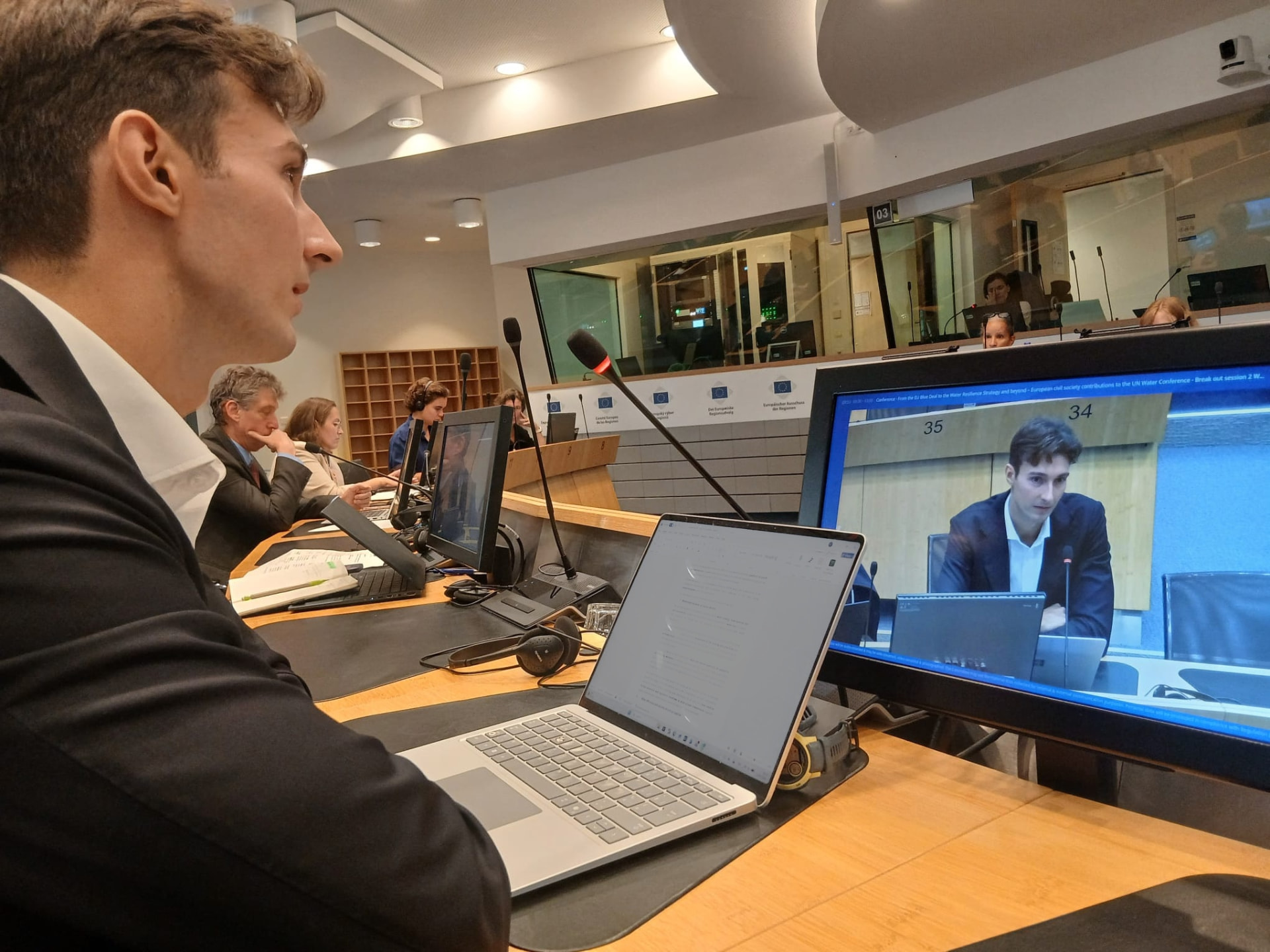
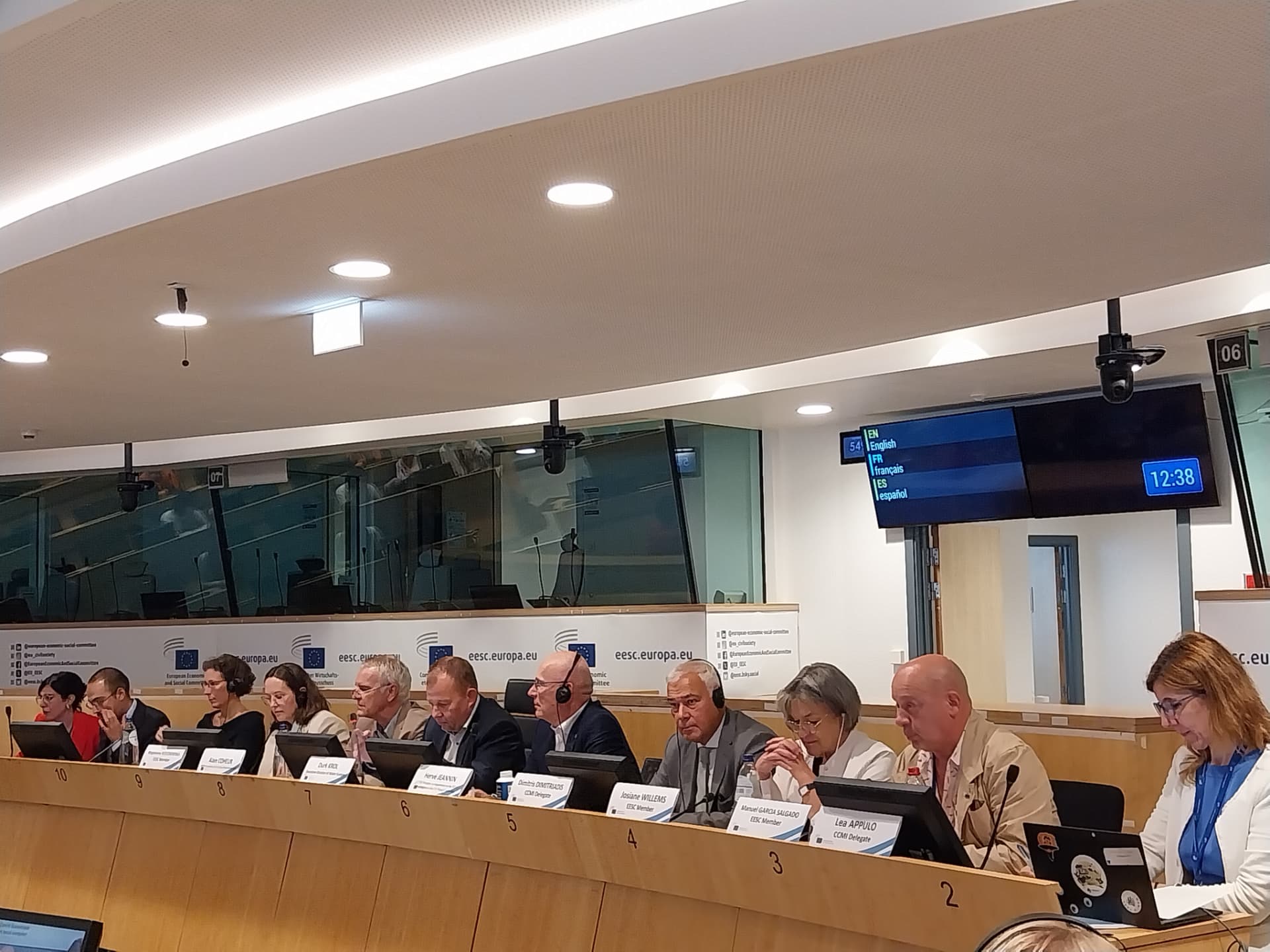
Le 15 septembre 2026, à Bruxelles, le Parlement Français des Jeunes pour l'Eau a pris la parole au Comité économique et social européen (CESE) lors de la conférence consacrée aux contributions de la société civile européenne à la Conférence des Nations unies sur l'eau de 2026.
Le PFJE y a présenté ses commentaires sur l'avis du CESE autour de deux axes : intégrer l'eau dans l'ensemble des secteurs et compléter les gains d'efficacité par une véritable sobriété des usages. Le document original, rédigé en anglais, est reproduit ci-dessous dans son intégralité.
French Youth Parliament for Water Comments
EESC’s Opinion ahead of the 2026 UN Water Conference
The French Youth Parliament for Water
The French Youth Parliament for Water (PFJE) is an initiative led by the Jeunesse pour l’Eau association. It brings together 30 young people aged 18 to 27 from across France, representing a wide range of backgrounds and perspectives.
The PFJE aims to ensure that young people’s voices are heard in water governance at all levels. It promotes democratic, inclusive and territorially representative participation across France’s river basins, through dialogue, awareness-raising and co-creation.
By fostering stronger links between young people, elected representatives and water experts, the PFJE contributes to a more equitable, sustainable and participatory approach to water management.
Our Recommendations
The French Youth Parliament would like to thank the EESC for consistently providing a platform for youth representatives to present their point of view, as it is not yet integrated throughout the entire policy-making process in EU or international processes.
Overall we believe the EESC has provided a satisfactory opinion, but we would like to see concrete implementation and a call for continued ambition better reflected during the 2026 UN Water Conference.
We have two mains comments concerning water can be mainstreamed across all sectors and how water efficiency improvements should be complimented by water sobriety.
1) Mainstreaming water across all sectors
We strongly support an integrated approach linking water, energy, food systems but also biodiversity, together with the establishment of a systematic “water test” to assess the coherence of policies with the objective of achieving sustainable water management.
However implementation should be the focus here. In practice, it is easier said than done and we would like to suggest a proper assessment of the existing best practices and available tools, including digital tools, that can be used to ease the mainstreaming of water across all sectors and streamline the coherence evaluation of policies to build a workable policy nexus.
Furthermore, we would like to add that the water test should especially be applied to our financing decisions to maintain coherence with our objectives. There is very little sense in financing nature protection and restoration while continuing to support projects and activities that contribute to its degradation and consequentially to the degradation of water resources.
We indeed observe that water tends to be treated as the variable that can be adjusted around the needs of the other sectors, due to its comparatively low cost compared to energy for instance. While conserving water affordability for all, there is a clear need for further economic and regulatory incentives to drive private investments towards water resilience and ensure that first movers do not end up being penalised.
2. Water efficiency and sobriety should go together
We welcome the strong emphasis on increasing water efficiency globally with a 10% efficiency gain for 2030 that could go up to 20% for 2040 where necessary.
Together with efficiency, the opinion rightfully identifies the use of alternative water resources, such as water reuse, as holding a strong potential. We encourage investments and the deployment of solutions that will cut water waste while increasing water availability.
However, we believe that the EESC should have a more ambitious opinion during the 2026 UN Water Conference and put a clear emphasis on the very foundation of building a more water resilient world, which is water sobriety.
Investments on water efficiency and water reuse only make sense if they go along with clear decisions on our water uses. As certain parts of the world consistently use more water than they receive, they invest massively in using water more efficiently and resorting to alternative water sources. The issue is that they are often linked to a rebound effect that ends up increasing water demand.
As highlighted in the EU Blue Deal and throughout this opinion, many regions of the world, including Europe, will face dwindling freshwater availability in the following decades.
To face this reality we will have two choices:
- Deciding together which water uses should be prioritised with the available water resources we will have, to become more water sober;
- or ignore the necessity of this conversation and condemn ourselves to facing the consequences of a self-inflicted state of water poverty, with all the social, economic and environmental consequences it entails.
Both scenarios entail certain sacrifices, but we believe that it is better to choose them as a society rather than to having them imposed upon us.
« To conclude and summarise the above: If the EU, and the world, are to create a “water smart society”, we should be smart together and have honest reflections involving all the stakeholders, including young people who will live with the outcomes of the decisions made today, on the sustainability and the necessity of certain of our water uses, from the local to the global scale. »
Contact
Parlement Français des Jeunes pour l’Eau
https://www.jeunessepoureau.com/home
Contact Co-présidence : albin.pinaudeau@etik.com ; halina.jacques@etik.com
Contact Vice-Présidence International / Europe : gufevrier@gmail.com
NOUS SOUTENIR
Votre soutien rend ces publications possibles
Le PFJE est porté par des jeunes bénévoles. Un don, même modeste, finance nos travaux, nos déplacements et nos consultations citoyennes.
À lire aussi
Tribune du Parlement Français des Jeunes pour l'Eau contre le projet de loi d'urgence agricole pour la protection et la souveraineté agricoles
Lire
Appel du Parlement Français des Jeunes pour l'Eau pour la préservation des poissons migrateurs, patrimoines vivants de nos rivières
Lire